Relocating from the UK to Germany for work in 2025 means navigating not just visas and paperwork, but also the fine print of your German employment contract. German labour law is highly detailed and protects employees far more than many UK expats expect. This guide walks you step by step through the types of contracts, key clauses, rights, deductions, and negotiation strategies — so you know exactly what to look for before signing.
📌 For the complete relocation essentials, see our pillar post:
👉 Expat Essentials for UK → Germany Moves in 2025 (Life Admin, Health, Banking & More)
1. Why Employment Contracts Matter for Expats
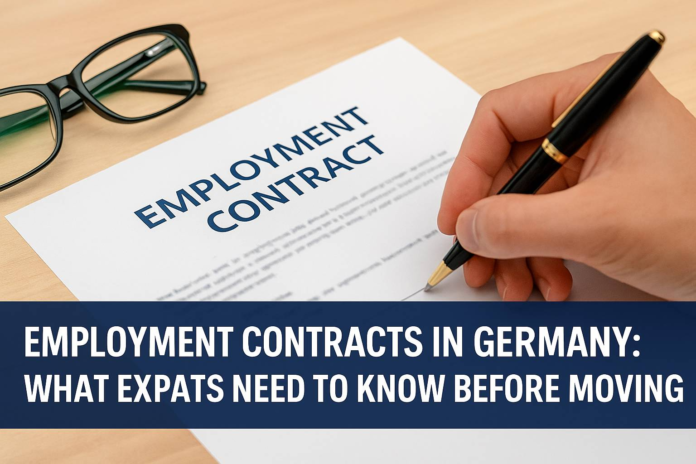
Your employment contract (“Arbeitsvertrag”) is more than a job offer. It’s a legally binding document under German Civil Code (Bürgerliches Gesetzbuch – BGB), spelling out duties, rights, benefits, and restrictions.
Without a clear contract, you can’t:
- Register for taxes (Steuer-ID).
- Apply for health insurance.
- Open a bank account (📌 Banking in Germany for Expats).
- Apply for residence permits.
Unlike in the UK, verbal agreements don’t hold up in Germany. A written and signed contract is mandatory.
2. Types of Employment Contracts in Germany
Permanent Contracts (Unbefristeter Arbeitsvertrag)
- Most common contract type.
- No fixed end date.
- Provides maximum employee protections.
- Default contract type if not otherwise stated.
Fixed-Term Contracts (Befristeter Arbeitsvertrag)
- Limited to 2 years maximum unless special conditions apply.
- Can only be renewed a limited number of times.
- Common in academia, research, and start-ups.
Probationary Contracts (Probezeit)
- Probation can last up to 6 months.
- During this time, both employer and employee can terminate with only 2 weeks’ notice.
Freelance/Service Agreements (Freier Mitarbeiter / Werkvertrag)
- Not technically employment.
- No paid holiday, sick leave, or protections.
- Common in IT, consulting, and creative fields.
📌 Related Reading: German Anmeldung Explained for Expats (Step-by-Step Guide)
See our comprehensive relocation strategy guide for more details and answers.
3. Key Elements of a German Employment Contract
Every employment contract must clearly include:
| Contract Element | What It Means | Expat Tip |
|---|---|---|
| Job Title & Duties | Scope of your role | Make sure it matches your job offer. |
| Salary & Bonuses | Stated as gross (before tax) | Ask if holiday & Christmas bonuses apply. |
| Working Hours | Usually 35–40 hours per week | Ensure overtime rules are written. |
| Annual Leave | Minimum 20 days (for 5-day week) | Many employers offer 25–30. |
| Probation Period | Up to 6 months | Easier termination rules during this period. |
| Notice Periods | Start at 4 weeks, increase with tenure | Can extend to 7 months. |
| Collective Agreements | Sector-specific union rules (Tarifvertrag) | Check if your industry is unionized. |
4. Rights & Protections Under German Labour Law
Germany’s labour law is famous for being employee-friendly. Expats often find it more secure than the UK system.
- Paid Holiday → Minimum 20 days, usually 25–30.
- Sick Leave → 6 weeks full pay from employer, after that health insurance pays partial salary.
- Maternity/Paternity Leave → Up to 3 years per child, job-protected.
- Termination Protection → After 6 months, dismissal requires social justification.
- Works Council (Betriebsrat) → Mandatory in companies with >5 employees; employee reps must be consulted.
📌 Authority Link: BMAS – German Federal Ministry of Labour and Social Affairs
5. Salary, Taxes & Payslips
Salary Structure
Contracts always state gross monthly salary. Expats are often surprised by deductions.
Deductions on Payslip
| Deduction | Approx % | What It Covers |
|---|---|---|
| Income Tax | 14–45% | Paid to Finanzamt |
| Solidarity Surcharge | 5.5% of income tax | Legacy reunification tax |
| Pension Insurance | 18.6% split employer/employee | Retirement fund |
| Health Insurance | 14.6% + surcharges | Medical coverage |
| Unemployment Insurance | 2.6% split | Safety net for job loss |
| Nursing Care | 3.05–3.3% | Long-term care |
📌 Related Reading: Health Insurance in Germany for Expats – Complete Guide
6. Collective Agreements (Tarifvertrag)
If you work in manufacturing, engineering, public service, or healthcare, chances are your contract is covered by a collective agreement.
These agreements set:
- Minimum wages.
- Annual leave.
- Overtime pay.
- Bonus entitlements.
👉 Official Source: Your Europe – Work Rights
7. Common Clauses Expats Overlook
- Non-Compete Clauses (Wettbewerbsverbot) → Can restrict you from working for competitors after leaving.
- Overtime Rules → If not specified, assume unpaid overtime up to 10% of hours.
- Bonus Structure → Not guaranteed unless written as contractual.
- Relocation Package → Some contracts cover moving costs, temporary housing, or language lessons.
- Language Clause → The German version is legally binding, even if an English translation is provided.
8. Negotiating a German Employment Contract
Unlike the UK, negotiations in Germany are less aggressive but still possible. Areas you can negotiate:
- Relocation support.
- Overtime pay clarity.
- Home office arrangements.
- Company pension contributions.
- Extra holiday (30+ days is not uncommon in senior roles).
9. Real Expat Case Studies
- Anna from London → Munich
Signed a permanent IT contract. Employer covered relocation costs & German classes. - David from Manchester → Berlin
Took a fixed-term research role. Contract did not include holiday bonus, but he negotiated extra leave days. - Corporate Relocation: Siemens employee from UK → Frankfurt
Employer handled Anmeldung, bank setup, and school enrollment for children.
10. FAQs About German Employment Contracts
Do I need Anmeldung before starting work?
Yes. Without registration, you won’t get a tax ID. See 👉 Anmeldung Guide.
Can I start with a UK bank account?
No. Salary must be paid into a German IBAN. See 👉 Banking in Germany Guide.
Do students need formal contracts?
Yes, but often as “Werkstudent” (working student) contracts with reduced hours.
What if my contract is only in German?
Get a certified translation. The German text prevails legally.
Can I refuse a non-compete clause?
Yes, but many firms insist. Compensation may be required if enforced.
Are employment rights the same for expats?
Yes. EU citizens, UK nationals with residence rights, and third-country workers under permits all have equal labour law protections.
11. Key Takeaways
- Most expats sign permanent contracts (Unbefristet).
- Contracts must cover salary, hours, leave, probation, and notice.
- German law provides strong employee protections.
- Always review for hidden clauses (overtime, non-compete).
- Connect contract details with life admin essentials: Anmeldung, bank account, health insurance.
📌 For the full relocation roadmap, check the pillar post:
👉 Expat Essentials for UK → Germany Moves in 2025